Pages


Showing posts with label Abbeyside. Show all posts

Monday, April 28, 2014

X is for Xmas 1895


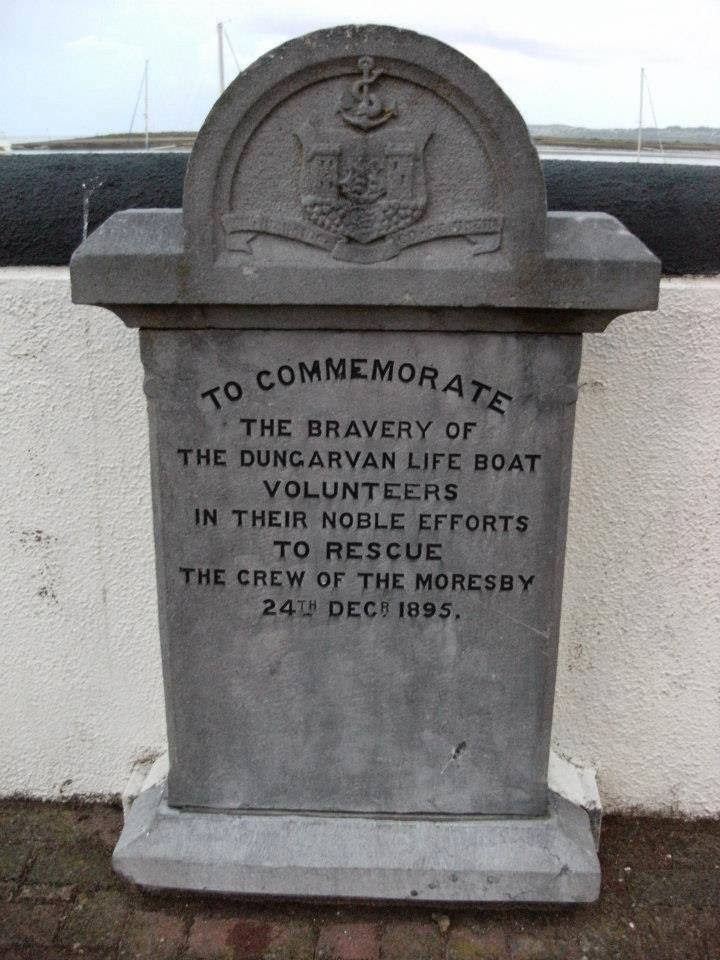
The Moresby Buoy

Photo: Donal Power
The Moresby was built at Whitehaven, Cumberland in 1882 She carried two lifeboats, a cutter, and a gig. On 21st December 1895 the Moresby left Cardiff, with a cargo of coal bound for South America and a crew of 23 including the Captain, Caleb Francis Coomber, the captain’s wife Edith Isabella and their 2 year old daughter Ivy.

Photo: Waterford Co. Museum
On December 23rd the ship ran into rough weather. At about 1p.m. the Moresby followed the schooner, the Mary Sinclair into Dungarvan bay. The Mary Sinclair was also in difficulty at this point. The keeper of Ballinacourty lighthouse saw that both ships were in distress and headed for shore at Clonea beach.

Photo: John Foley Images
The Mary Sinclair ran aground on the beach but the Moresby changed course. It steered towards the lighthouse and set anchor, about ¾ of a mile from the lighthouse. The Ballinacourty Lifeboat set out for the ship but the crew decided to stay with the ship. During the night the weather deteriorated and the Moresby sent out distress signals.

Photo: Waterford Co. Museum
About 4.30 a.m., the anchor broke and the ship went on its side. The captain, his wife and child, along with eleven crew members had to climb on the mizzen rigging. By 11a.m. the masts had dropped closer to the water. The crew saw no sign of a lifeboat coming to their rescue and decided to swim for shore. The Captain put his daughter on his back and jumped into the sea, followed his wife. But an ebb tide pulled them away from the coast.

Photo: Waterford Co. Museum
The Ballinacourty lifeboat, manned by a volunteer crew from Dungarvan, set out to rescue the crew, most of whom were in the sea.

Photo: Bet I Can Get 5000 That Love Dungarvan
The bodies of the captain, his wife and daughter were washed ashore. All three are buried together in the one grave. The Moresby was wrecked in Dungarvan Harbour on Christmas Eve 1895. Twenty out of the twenty five aboard were drowned.

Photo: Waterford Co. Museum
In 1899 a wigham light buoy was placed at the site of the wreck. This buoy marked the wreck until 20th December, 1906. It was beached for some years and in 1930 the lamp was reconditioned and the buoy was put back on site, until August 1954 when it broke its moorings in a gale, and was brought in to the Causeway.

Photo by me
The restored bouy sits on the Causeway which joins Dungarvan and Abbeyside as a memorial to those who died aboard the Moresby and  as a tribute to the gallant men, who manned the lifeboat, one of whom lost his life. 

Photo: Bet I Can Get 5000 People That Love Dungarvan


Tuesday, April 15, 2014

N is for Norman Ruins


Norman Ruins

Photo by Colette's Deise Views

The Augustine Abbey in Abbeyside was built by the McGrath family in 1290.  A well-proportioned building consisting of a chancel connected by an arch to the tower and a narrow nave. 

Photo by @Brian T McElherron shared by
Bet I Can Get 5000 People That Love Dungarvan

An archway leads into the nave. At the foot of the entrance is a slab with the Latin inscription:

“Hic iacet Donaldus Macrah qui obit XXVII die mensisi Marcii annno do’ MCCCC Septuagesimo”.         

Translation:  
“Here lies Donaldus Macrah who died on 27th March
 in the year of the Lord 1470”


Photo by Eddie Cantwell

The south wall has two large pointed windows and one smaller rounded one.

Photo by Eddie Cantwell

The large window in the east wall frames a picturesque view of the sea.

Photo by Clog

In December of 1649 Cromwell’s army marched from Waterford towards Dungarvan killing and maiming as he went. In an effort to wipe out Catholicism he destroyed religious property and churches, in his wake.The Abbey fell victim to Cromwell's ire. He attacked the Abbey and left it in ruins.  

Photo by Eddie Cantwell

The church was rebuilt in 1820 on the foundations of the Abbey. Rubble from the earlier building was integrated with the new. Also salvaged was the Abbey's coat of arms. A Griffin and three scallops shells. There is also a carving of a bishops head and carved capitals thought to be from the cloister.  

The ruins of the Augustinian Abbey, in Abbeyside, dominates the landscape of Dungarvan Harbour. 
A Magnificent View.
 A Beacon to those of us who call Abbeyside home. 


Monday, April 7, 2014

D is for Da' Bridge


Da' Bridge Historically known as Devonshire Bridge.

Bet I can get 5000 People to Love Dungarvan

Referred to by locals as Da'Bridge or
The Causeway Bridge.


Da’ Bridge is single span, and bridges the Colligan River. It links the town of Dungarvan to the village of Abbeyside. The bridge was financed by the 5th and 6th Dukes of Devonshire and constructed with sandstone imported from England. Hence the name.  


Photo by Ronan Flynn

In this grassy area, Abbeyside boys hid and fired stones at the Dungarvan boys (Townies) attempting to cross the bridge to date Abbeyside girls. They weren't very unsuccessful in their efforts. My mother was an Abbeysider. My father was a "Townie".  


Photo from Bet I Can Get 5000 People to Love Dungarvan

In the early fifties a favorite spot for members of the Dungarvan Swimming Club dived off. An activity my mother and my father’s sister participated in. I wonder if my grandparents were aware of this dare devilish behavior. I would think not as they lived long enough to marry and have children.  


Photo from Bet I Can Get 5000 People to Love Dungarvan


Due to lack of WiFi while at a writers conference I was unable to post D,E and F on time. But I took on this challenge and plan to see it through.

Saturday, February 6, 2010

Such A Simple Question, Or Is It?

I recently received an award from Old Kitty over at Ten lives and second chances. Thank you so much for this award Old Kitty, I am thrilled. I will be posting the award later.

First I must figure something out. This award requires one word responses to questions. For most this would not pose a problem. But true to my usual form, it is a problem for me! The question that has me stumped is...
Where did you grow up?

This is not a one word response for me. So I need to mull over this and decide what place to choose. Should I draw from a hat?


To start with, I left Abbeyside, Co. Waterford when I was two years of age. Moving
to Brooklyn NY. I lived in Brooklyn for two and a half years and then returned to Abbeyside for six months. From there it was back to Brooklyn where we stayed for another two years. We then moved to Chicago. We lived in Chicago for five years before moving to Madison,Wisconsin. Well Monona actually. We lived in Monona for two years and then moved back to Abbeyside for a year. We left Abbeyside and returned to Monona, WI for another two years. After which we returned to Abbeyside were I stayed until I got the civil service in Dublin.

Can you see my dilemma! I suppose I could take a letter or two from each place put them together and see what I come up with. Lets see, how about Abbrobyoklchimonsidonaey


I think that sums it up. Or maybe you have a better idea